Friday, 30 September 2022

LBC Radio interview on 8 August 2021 - Taser Use on Minors & Elderly

The work of The Police Action Centre is to campaign and challenge the use of Taser in routine policing.

 Here is my interview on LBC Radio on  8 August 2021.


Sophie Khan of the Police Action Centre alleges 'there is no risk assessment at all' when police use tasers against the public, telling Andrew Castle that a 'failure of training, policy and oversight' 'is at the heart of the issue

Wednesday, 8 June 2022

Stop and Tase? Cover Story in CL&J Weekly on May 18, 2013. Vol.177 No.20

Blast from the past. 

My cover story on Stop and Tase? in the CL&J Weekly on May 18, 2013. 

Vol.177 No.20


Saturday, 20 June 2020

Featured in Guardian Week ‘It should be the last option, not the first’: what's behind the rise in Tasering? -16 February 2019 by Sally Williams


“If you are vulnerable in any way, you’re more likely to be Tasered because of the officer not understanding what’s going on,” says Sophie Khan, a solicitor advocate who specialises in Taser-related injuries. In other words, a police officer may see the combative behaviour – not obeying commands, or aggression – and not the underlying cause behind it: a learning disability, perhaps, or mental breakdown.

The government-appointed body that oversees Taser use, the Scientific Advisory Committee on the Medical Implications of Less-Lethal Weapons (SACMILL) has acknowledged that certain people may be at risk of being Tasered simply because of who they are. In a statement published in 2012, the list is long. Mental health conditions, learning difficulties and neurodevelopmental or neurobehavioural conditions (for example, cerebral palsy and autistic spectrum disorders) may “negatively influence how affected individuals interact with the police”. The point might be: “Don’t be different”.
Police say this is misleading. “Yes, a Taser is more likely to be used on vulnerable people, but in the majority of incidents the device isn’t fired,” says Michael Brown, a mental health coordinator at the College of Policing and for the National Police Chiefs’ Council. A Taser is described as being “used”, even if the gun is drawn but not fired. Merely taking aim, says Brown, is a very effective deterrent. He argues that Tasers can save lives. “If somebody is posing a risk, the police have to police that, regardless of whether the risk comes from straightforward criminality or whether it’s from drugs and alcohol use, learning disability or mental illness. By the time the police are crisis-managing risk situations where people are self-harming, non-communicative and posing a risk to themselves or others, it might – just might – be the least worst option available.”
***
On 3 February 2013, Talhat Rehman, now 58, a halal butcher from London, jumped the barricades outside Buckingham Palace, where crowds had gathered to watch the changing of the guard. He had two large kitchen knives, which he waved in an aggressive manner, according to police, and went on to hold one knife to his own throat.
“The disturbance obviously caused a great deal of alarm to members of the public,” observed Peter Zinner, the prosecutor in the trial at Southwark crown court on 27 March 2013. “The police had no option but to deploy Tasers.” Rehman fell to the floor and officers retrieved the knives. He was taken into police custody and charged with affray and two counts of possession of a knife in a public place.
Rehman was sectioned. When he was considered well enough to be tried, he pleaded guilty to the two counts of having a knife in a public place (the charge of affray was dropped after Rehman’s barrister said there was no evidence that he wanted to hurt others, only himself). His son, Kassum Raja, one of Rehman’s five children, explained in court that his father had lost £170,000 in a financial scam. The episode, in his view, was the culmination of months of worry and anguish. On 17 May, Rehman was sentenced to a 12-month community order, including mental health treatment and a supervision order.
Rehman lives with his wife, his son’s family and his parents. When I visit Abdul, his father, 86, a trustee of Brent mosque, he explains that Talhat is in Pakistan seeing family. We talk about the Tasering and he confirms that his son had been “disturbed mentally” by money worries at the time; he had gone to Buckingham Palace to get help from the Queen. “He loves the Queen. We all love the Queen. He must have thought she’d help him out.”
The first he knew of the incident was when he saw it on the news: “We were very hurt and surprised.” But Abdul is not entirely critical of the police. “They are professional people, obviously they know what they are doing. But we thought it was wrong when they Tasered him. The knife, you know, was just there” – he points to his throat – “he could have fallen on the knife and hurt himself.”
However, Abdul says the experience further unsettled his son and that it wasn’t an appropriate use of force for someone with mental health problems. “He was very affected by it – it upset him a lot.”
In November 2013 Talhat Rehman contacted Sophie Kahn. “The entire episode had traumatised him,” Khan says. “He said he used to have flashbacks about being Tasered, and being dragged to the floor and handcuffed. They were quite rough with him at the scene.”
In her view, Rehman should never have been Tasered. “Had he been thrusting the knives at the police officers I would have understood – they’ve got to protect themselves, but both knives were pointed to his body.”
Even if Tasering Rehman was justified, Khan says, the situation should never have got to that point. She discovered that police had known about his unstable mental health for at least two years before the incident. They had visited his home to discuss letters he had sent to the BBC, the Queen and the Metropolitan Police commissioner, threatening suicide outside Buckingham Palace. Five months prior to being Tasered, he was arrested outside the Palace of Westminster. He was stopped, searched and found to have a knife. Police had been tipped off – by Rehman himself. “He contacted Brent Mental Health Service and the police to notify them of his plan,” Khan says. Rehman was sectioned and taken to a secure hospital.
In Khan’s view, the case demonstrates how the police could have averted the situation. “The police knew he wasn’t well. Why didn’t they do something? They could have referred him to a team who could have come up with a care plan – then he would have been in regular contact with mental health services.”
Almost a year after he was Tasered, Rehman wrote a letter of complaint to the police. He argued that the restraint was “unlawful” and that “police had failed to safeguard his welfare prior to the incident”. He received a response on 26 February 2015. They said that in their opinion there was “insufficient evidence” that the restraint against him “was unlawful”.
In the view of Michael Brown, the police mental health coordinator, the case is a textbook example of Taser use; one that is likely to be used in training. “He was presenting a threat, which means you wouldn’t want to get close to him in case he hurt you with a knife.” Officers “managed to mitigate that risk” by using the Taser. The incident “also had the benefit of being videoed at close range [by bystanders] so there’s perfect footage of it”. Of course, he adds, Rehman’s previous contact with the police is significant. But “the fact that the police knew something doesn’t mean the officers on the ground knew something”.
***
Spencer Beynon was born in Llanelli, south Wales in 1972. His father, Chris, 75, was a double-glazing salesman, and his mother, Margaret, 73, a housewife. He grew up a very happy, rugby-playing boy who had plenty of friends and was close to his family. He met his wife at 23, after a seven-year stint in the army. Ellen, now 40, was a hairdresser in Llanelli. “He and his friends used to come in and go on the sunbeds,” she remembers, “He was a charmer.” They had two children, Victoria, now 19, and Jacob, now 15, but separated after four years of marriage. “We just drifted apart, but we were friends always.”
In 2005, Beynon decided to go back into the army, and wanted to prove he could still make it at 33 by joining the elite Parachute Regiment (the Paras). “He said, ‘If I’m not fit enough for the Paras – the fittest of them all – I’m not fit to go back into the army,’” his father says. “He worked himself very hard.”
After successfully completing the training, Beynon transferred back to his old regiment – the 2nd Battalion, The Royal Welsh. He was deployed to Iraq and then Afghanistan, where several deeply traumatising events changed the course of his life.
Three months after arriving in Iraq, Beynon witnessed the death of his childhood friend, Ryan, when his vehicle was hit during a night operation. Beynon, who was in the vehicle behind, retrieved his friend’s body from the wreckage. “It was a policy with the boys, an unwritten law, get them out,” his father explains. “What they see out there, we haven’t got a clue.”
There were other pivotal events: the death of a baby during a search-and-recovery operation in Basra; the fatal injury of another army colleague in Helmand, Afghanistan. “Spencer and the nurse stayed with him for an hour and a half waiting for the helicopter to come. It was absolutely horrific. And people ask, ‘Why did he have post-traumatic stress disorder?’” his father says.
In December 2011, Beynon found out that Ryan’s mother, Alison, had died from cancer before Beynon had a chance to speak to her. Deeply affected by her death, he left the army and moved back home with his parents in Llanelli. “Alison’s death did something to his head,” his mother says. “I’d hear him in the night screaming.” He’d take a bottle of Jack Daniel’s and sit by Ryan’s grave. “He was totally obsessed with Ryan’s death,” his mother says. “He’d lie in his bedroom for days and wouldn’t wash – and my son was immaculate,” she says. He tried to escape into cannabis and alcohol. When his mother complained, “he’d say, ‘Leave me alone. It’s the only thing that takes the memories away.’”
On 14 June 2016, at around 7pm, neighbours contacted police to say Beynon was acting strangely. He was by now living in a cul-de-sac near the seafront, about a 15-minute drive from his parents’ house. His great love was Ganesh, a Boston terrier. “The dog kept him alive,” says his father. “If it hadn’t been for the dog, he would have taken his own life years ago.”
According to witnesses, two officers from Dyfed-Powys police arrived at the scene at around 7.30pm. They found Beynon slumped on the pavement with a self-inflicted cut to his throat. He was bleeding heavily. He’d also turned on his dog, inflicting such severe injuries that he had to be put down. Within minutes of the officers arriving, Beynon was Tasered. He died soon afterwards. He was 43.
Three years later, Beynon’s family are yet to receive answers about why police used a Taser, and whether that contributed to his death. Since August 2017, there have been five pre-inquest hearings. In one, last June, Sophie Khan, who represents the family, told the court that the officer who fired the Taser described Beynon as getting up and “charging” at the officers, but none of the other witnesses described him getting up, including the other officer.
At the fourth hearing, last October, it was revealed that Beynon’s father, Chris, had called the police that morning asking to have his son sectioned under the Mental Health Act for his own safety; this call was not acted on. “When the police attended the scene and saw Spencer Beynon bleeding they had an obligation to provide him with first aid, to protect his life,” Khan told the pre-inquest. “That did not happen.”
The barrister representing Dyfed-Powys police said Beynon had died from the wound to his neck; that the Taser “played no part” in his death, adding: “Three experts are of the unanimous view that a Taser was not the cause of death.” This included Anthony Bleetman, a freelance consultant who advises on emergency medicine for SACMILL, and one of three expert witnesses appointed by the coroner to comment on Taser use in this case. In his view, Beynon had an “in-survivable neck wound” and was beyond saving.
But Khan raised another concern at the hearing: conflict of interest. Not only had Bleetman been instructed by the IOPC as part of its investigation into Beynon’s death (“the coroner should appoint its own experts,” she said) Bleetman has an ongoing professional relationship with the police, providing advice and training in the use of force for two decades. “He can’t be classified as an independent expert,” she stated. Bleetman also has a prior relationship with Taser International. He was paid by them to write a literature review of Taser-related injuries in 2001.
“We are talking about a very modest sum, going back 20 years, which was always declared,” he says when we speak. Is there a conflict of interest? “That is a matter for discussion, but my approach to these things is straightforward: every time I am asked to comment on a Taser case, the first thing I do is alert the chair of SACMILL. His response has always been ‘Just declare everything’. It’s up to the courts to determine whether they consider my evidence to be truly independent or not.”
Bleetman defends the use of the Taser on Beynon. “We are talking about an individual who cut his own throat. Who did what he did to the dog. And in the cool light of day after the event, we say, ‘Well, why didn’t you talk to him? Why didn’t you guide him away?’”
A date has yet to be set for the inquest, but it’s unlikely to be this year. “For the family who have lost someone in tragic, complicated and distressing circumstances, the lack of clarity around what happened and why is only adding to their distress,” Khan says.
“We just want to get justice for Spencer,” says Ellen. “We want to get answers so we can move on.”
***
https://www.theguardian.com/world/2019/feb/16/last-option-not-first-rise-tasering

ITV London - Interview on #Tasers - 3 September 2019


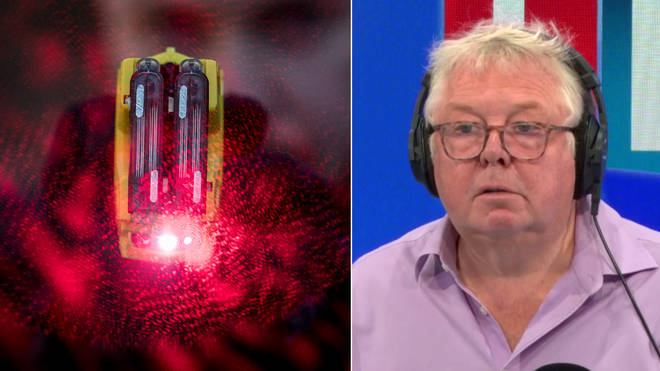
Nick Ferrari's Furious Row With Lawyer Who Doesn't Want Police To Have Tasers - 20 August 2019


Nick Ferrari told a lawyer who specialises in representing people who are injured by tasers that she knows nothing about policing.
The Chief Constable of Northamptonshire Police has announced he is to offer tasers to all his officers who want one.
And when lawyer Sophie Khan said she didn't think tasers were the answer, things started to get very heated.
Nick Ferrari's interview with a lawyer got very heated
Nick Ferrari's interview with a lawyer got very heated. Picture: PA / LBC
Ms Khan insisted that if an officer was dealing with a person with a knife then the Territorial Support Group - the specialist officers who do carry a taser.
But Nick pointed out that these incidents happen very quickly and in rural Northamptonshire, there would be no time to get specialist officers to the scene.
Nick asked again what an officer without a taser should do if someone is coming towards them with a sword and her response was: "Ask him why he's got a knife. Ask him to put the knife down."
That led Nick to tell her: "I think you are to policing what I am to ballet dancing.
"You haven't got a clue have you, respectfully, of actual policing?
"Your knowledge of law I'm sure is exemplary, but actually out on the streets, you ask him what he's doing? He's coming at you with a sword!"
It was a remarkable row - watch it at the top of the page.
https://www.lbc.co.uk/radio/presenters/nick-ferrari/nick-ferrari-furious-row-with-lawyer-tasers/

Saturday, 20 August 2016

Interview on BBC Radio 4 - Today Programme -16 August 2016

Taser regulation 'not strong enough'

Former Premier League footballer Dalian Atkinson has died, aged 48, after being shot with a Taser by police at his father's house.
Sophie Khan, a lawyer specialising in Taser injuries, explains to presenter Matthew Price her concerns about Taser training and regulation in the UK and questions the amount of force used by the police.
(Image: Dalian Atkinson. Credit: Getty Images)

Release date:

Duration:

3 minutes

http://www.bbc.co.uk/programmes/p044vd24

Interview on Good Morning Britain - 16 August 2016 - Taser Death

Interview on Good Morning Britain 
Taser Death


http://www.express.co.uk/showbiz/tv-radio/700481/Dalian-Atkinson-Taser-Telford-Police-Federation

Saturday, 18 July 2015

Interview on BBC South Today 16 July 2015 - Tasered men awarded payout by Dorset Police

Interviewed on BBC South Today on payout by Dorset Police to Taser victims.

http://www.bbc.co.uk/programmes/b061sw9h


http://www.bbc.co.uk/news/uk-england-dorset-33547218

Tasered men awarded payout by Dorset Police -16 July 2015

Tasered men awarded payout by Dorset Police

Two stag do revellers who were Tasered and pepper-sprayed by police have each received a five-figure payout.
Brothers-in-law John Naylor, 53, and Darren Corbridge, 40, were stunned by officers in Weymouth town centre in August 2010.
They had been trying to help groom Stewart Roberts - who was in dressed up as male genitalia - get a taxi.
Sophie Khan, the two men's solicitor-advocate, said the use of the weapon had been excessive.

'Excessive force'

A Dorset Police spokesperson said: "Dorset Police can confirm that an out-of-court settlement has been reached, with no admittance of liability."
He added: "It is not our practice to comment on the settlement amount."

null
The National Police Chiefs Council has asked for an independent review into the safety of Tasers

Ms Khan said police also paid legal costs of £90,000.
Her clients were found guilty of attacking police in relation to what happened, but in 2012 Mr Corbridge and Mr Naylor had their convictions overturned by a judge who was shown the CCTV of the incident.
Ms Khan said: "The claim by Mr Corbridge and Mr Naylor followed a serious incident in Weymouth town centre where the use of force on them was so excessive it had to be challenged.
"I hope Dorset Police can learn from this and that it doesn't happen to anyone else."
There are about 70 officers trained to deploy Tasers in Dorset.
The National Police Chiefs Council has asked for an independent review into the safety of the weapons.
It follows a recent inquest in which a jury found the use of a Taser to restrain 23-year-old Jordon Begley in Manchester in 2013 was a factor in his death.

Wednesday, 11 February 2015

Interviewed on RT UK - 10 February 2015


'Give all officers Tasers to combat terror threat’ – UK Police Federation

http://rt.com/uk/231059-police-tasers-request-terrorism/


Interviewed on BBC News Weekend - 31 January 2015

'Tasers for all front-line officers' - Police Federation


Sophie Khan, a solicitor, said the weapons were being used too often.
People who are mentally ill are being tasered; people from a certain minority background are being tasered," she said. " When there is an incident, the taser comes out and the person is tasered without really going through the motions of what it is that's happening in front of them.")


Saturday, 17 January 2015

Quoted in MailOnline - MoD spend £360,000 on #Tasers - 17 January 2015

MoD police spend £360,000 on huge stockpile of Tasers - despite using the weapons just ONCE in eight years

  • Two thirds of MoD's 363 Tasers have been bought since April 2013
  • Yet just one of the 50,000-volt weapons has ever been discharged  
  • The MoD insists they are needed as a non-lethal alternative to guns
  • But Shadow Defence Secretary told MailOnline figures appeared 'chaotic'
  • And Home Secretary has ordered review amid heavy use on mentally ill
A police force is building up a huge stockpile of Tasers which cost £150,000 in the last nine months alone - despite using the controversial weapon just once in eight years.
Campaigners have condemned the spend by the Military of Defence police, which has had to cut millions of pounds from its budget and sack 800 officers - a quarter of the workforce - since 2010.
Figures seen by MailOnline reveal the force, which guards military bases around Britain, spent £361,185 on 363 Tasers since the weapons were introduced in 2007.
Charge: Ministry of Defence police have spend £360,000 on Tasers, including £150,000 since April alone - despite using the controversial 50,000-volt stun guns just once in the last eight years (photo posed by model)
Weapon: The force has almost 400 of these X26 Tasers, which it says are a safer alternative to guns
Some 217 of those, almost two thirds of the entire stock, were bought since April 2013 after police inspectors said they should become commonplace.
Yet they have been drawn from their holsters no more than 13 times.
A Taser was discharged on a suspect just once, during an incident in 2011 which was not within the force's normal remit.
Seven Tasers were aimed using a ‘red dot’ laser sight, and the remaining five were drawn but not aimed. Not a single Taser was drawn from its holster in 2013.
Those figures could now fall even further after Home Secretary Theresa May called for the use of Tasers to be reviewed amid claims they are used too much on vulnerable people.
A report found 30 per cent of people Tasered in London in 2011 had mental health issues - and half were from ethnic minorities.
Mrs May told a summit in October: 'Imagine what it is like for the thousands of people with mental health problems, learning disabilities or other vulnerabilities who regularly encounter the police... people who are confused, distressed and disorientated.
Crackdown: Home Secretary Theresa May called for the use of Tasers to be reviewed amid claims they are used too much on vulnerable people. She told a summit in October the experience must be 'terrifying'
Killed: Andrew Pimlott, 32, burned to death after a Taser was fired despite him dousing himself in petrol
'And then imagine if that encounter also leads to physical restraint, or even being Tasered by the police.
'Imagine being transported to hospital not in an ambulance, but in the back of a police car. Or being detained in a police cell rather than a health-based place of safety or mental health ward.
'That encounter must be terrifying.' 
The X26-series weapons currently cost £1,050 each and are made by the U.S. firm Taser International in a 100,000 sq ft complex in Scottsdale, Arizona.
On patrol: Armed Ministry of Defence police on guard in Whitehall, central London (file photo)
They are already common in U.S. police forces and the firm, whose motto is ‘Protect Life. Protect Truth’, claims they have ‘transformed law enforcement and become a vital tool’.
But despite bringing down injury rates in U.S. states where they are used instead of guns, the weapons have been at the centre of several scandals.
A British father died of severe burns after police Tasered him - despite the fact he had doused himself in petrol.
Andrew Pimlott, 32, was set on fire by the 50,000-volt charge outside his Plymouth home where he had threatened to take his own life.
The Independent Police Complaints Commission immediately launched an investigation into the 2013 incident and has since handed a file to prosecutors.
The Ministry of Defence police force has around 2,600 officers, the vast majority of whom are armed, guarding more than 50 strategic sites across the UK including army, navy and RAF bases.
Officers also guard the MoD offices in Whitehall, the 35-acre Royal Mint headquarters in Llantrisant, south Wales, the Aldermaston Nuclear Weapons Research facility in Berkshire and nuclear submarine bases on the River Clyde.
Responding to today's figures, released under the Freedom of Information Act, the MoD insisted Tasers were needed as a non-lethal alternative to guns. 
But the costs were slammed by campaigners and Labour's Shadow Defence Secretary Vernon Coaker.
Mr Coaker told MailOnline: 'It seems strange that despite Tasers being used just a handful of times since 2007, the Ministry of Defence has ordered 217 in the last 18 months.
'Why does the MoD Police need increased Taser capability, given how little it is used and the fact that officers already armed?
Facility: Among the sites guarded by the MoD's force is the Royal Mint headquarters in Llantrisant (pictured)
Stun: The Tasers' manufacturers insist they have saved lives where they are used instead of bullets
'Over 90 per cent of the Defence Police carry firearms as part of their duties, enabling officers to protect themselves as well as the assets and personnel they are guarding.
'Is this just another example of chaotic defence procurement that has seen millions of pounds wasted under this Government? British taxpayers will want to know the answer.'
Campaigning lawyer Sophie Khan, who brought a landmark High Court case in 2013 accusing the Metropolitan Police’s Taser roll-out of being unlawful, said: ‘There is a concern about why they have bought so many, where obviously there’s not a need for them.
‘The MoD police are facing financial issues and the money obviously could have been spent in other areas - training, equipment or safety.
‘Given the Home Secretary’s speech in October, the likelihood is there’s going to be a decrease in the coming years because she’s very concerned about them.
‘It’s going to be a lot of wasted money if the Home Secretary comes back after the review and says “we only need one Taser for X number of officers”.’ 
Opposition: Campaigning layer Sophie Khan said there was 'obviously not a need for them'
Shadow defence secretary Vernon Coaker suggested it could be more 'chaotic defence procurement'
Opposition: Campaigning layer Sophie Khan (left) said there was 'obviously not a need for them'. Shadow defence secretary Vernon Coaker (right) suggested it could be more 'chaotic defence procurement'
Amnesty International UK Arms Control Director Oliver Sprague added: 'Tasers are potentially lethal weapons and we’ve always said they should only be used when there’s a clear threat to life or of serious injury, and only as a last resort by high-trained law-enforcement officers.
'What’s baffling here is why the MOD police are spending vast amounts of money on a weapon for which there seems to be so little need.
What’s baffling here is why the MOD police are spending vast amounts of money on a weapon for which there seems to be so little need 
Oliver Sprague, Amnesty International
'We’re already worried by the way our police authorities seem to think that more and more weaponry is the solution to every policing problem.
'We only want to see the police and the MOD purchasing Tasers if there’s a clearly demonstrated security and policing need.' 
The Ministry of Defence said the increase in Taser numbers was recommended by HM Inspectorate of Constabulary.
'HM Inspector of Constabulary did a routine police firearms inspection in 2013 and recommended that all front-line officers (forward facing or public facing eg on the steps of Main Building) be trained to use Tasers, as a “less lethal” option to the use of firearms,' a spokesman said.
'It is mandatory in the police world for firearms officers to have a range of other options to deploy, to reduce the potential for recourse to conventional weapons.
'Currently there are fewer than 400 Tasers in the Force, and the stock is shared.
'Obviously a number are used in standard police training, and some will be damaged and need to be replaced on a continuous basis.' 
The one time an X26 Taser was deployed, the incident was outside the MoD force's normal remit (file photo)
The spokesman added a Taser was discharged once by the force in 2011, during a domestic incident in which a man with a knife was threatening two women.
The incident was not within the normal remit of MoD police, but officers were tasked because they were nearby and 'successfully defused a life-threatening situation'.
'MoD Police train all Authorised Firearms Officers in the use of Taser in accordance with national armed policing policy. 
'The MoD’s Police Committee, which is independently chaired, and whose role is to oversee the proper functioning of the MDP, supports the recommendation from HM inspectorate of Police (HMIC) in 2013, that MOD Police increase Taser training to all public-facing officers, and is tracking progress on its implementation.'

STOCKPILE: HUNDREDS OF TASERS BOUGHT BY MOD POLICE...

2007/08 - 39 (Cost: £31,200)
2009/10 - 49 (£45,325)
2010/11 - 20 (£19,500)
2011/12 - 30 (£29,350)
2012/13 - 8 (£7,960)
2013/14 - 67 (£70,350)
2014/15 - 150 (£157,500)
TOTAL - 363 (£361,185)

... BUT THEY HAVE HARDLY BEEN USED SINCE THEY ARRIVED

2008 - Drawn: 1  Aimed: 2  Discharged: 0
2009 - Drawn: 0  Aimed: 0  Discharged: 0 
2010 - Drawn: 1  Aimed: 1  Discharged: 0 
2011 - Drawn: 3  Aimed: 1  Discharged: 1 
2012 - Drawn: 0  Aimed: 1  Discharged: 0 
2013 - Drawn: 0  Aimed: 0  Discharged: 0 
2014 - Drawn: 0  Aimed: 2  Discharged: 0 
TOTAL - Drawn: 5  Aimed: 7  Discharged: 1


Read more: http://www.dailymail.co.uk/news/article-2856651/MoD-police-spend-360-000-huge-stockpile-Tasers-despite-using-weapons-just-eight-years.html#ixzz3P7NXL1hE
Follow us: @MailOnline on Twitter | DailyMail on Facebook